
Island vs Mainland: What 11,000 Car Rentals Reveal About Island Pricing
We analyzed over 11,000 island bookings across 19 destinations. Islands should be more expensive. Limited supply, captive markets, ferry logistics. The data tells a different story.
The Island Pricing Expectation
Common wisdom says island rentals cost more. The logic makes sense. Limited vehicle inventory. Captive customer base. Higher logistics costs from ferry transport. Less competition from nearby cities.
When we pulled over 11,000 completed island bookings from our platform, we expected to confirm this pattern. Islands would show a premium over comparable mainland cities.
That's not what the numbers show.
The Actual Numbers
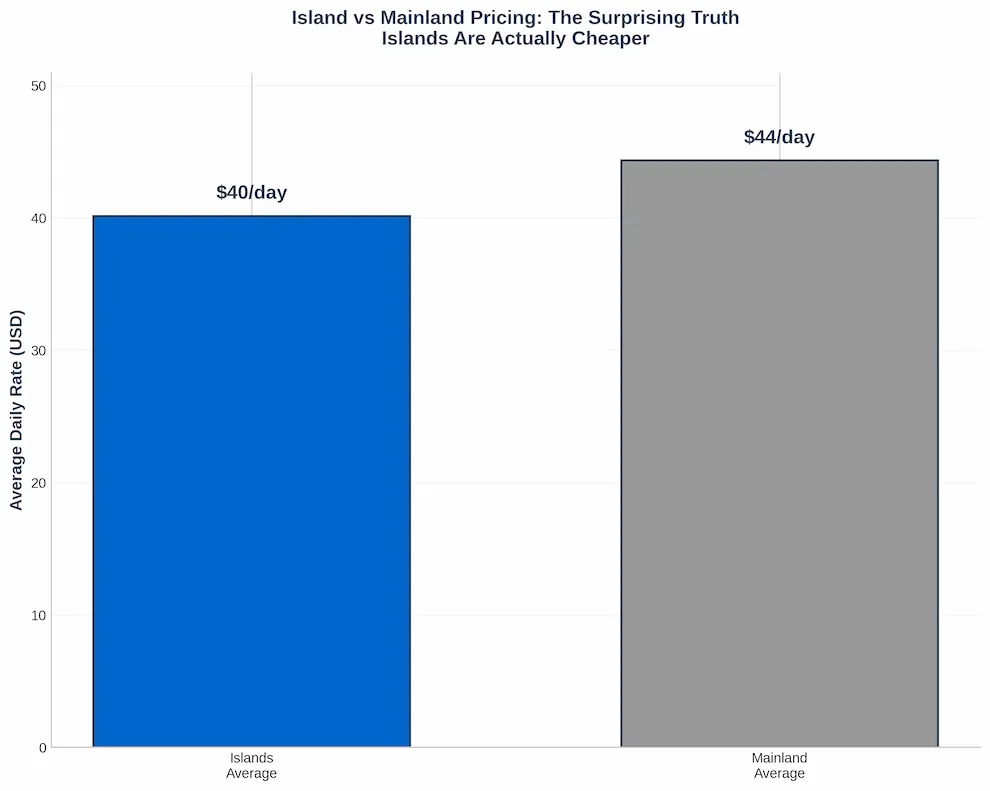
Islands average $40 per day. Mainland cities average $44 per day. That's 9.4% cheaper on islands, not more expensive.
This isn't a small sample showing outliers. We analyzed over 11,000 island bookings and over 17,000 mainland bookings across 19 island destinations and 19 major mainland cities.
The difference holds across major markets:
Spanish islands vs Barcelona: Islands average $28 per day. Barcelona costs $38. That's a $10 daily savings on islands.
Italian islands vs Rome: Catania costs $34. Palermo costs $42. Rome costs $40. Sicily matches or beats the mainland.
Hawaii vs US mainland: Honolulu costs $52 per day. The US mainland average is $52 per day. No island premium exists.
Why This Pattern Exists
The answer lies in competition and tourism infrastructure. Mass tourism islands have fierce competition for Northern European visitors. Multiple rental companies compete for the same customers. High season volumes support year-round operations.
Spanish islands exemplify this. Mallorca, Tenerife, Ibiza, and Menorca all target the same Northern European market escaping winter. That creates pricing pressure. Companies compete on rate to fill their fleets.
Mainland cities serve mixed markets. Business travelers, domestic tourists, and international visitors all use different booking patterns. Less concentrated demand means less aggressive pricing.
Three Types of Islands
Not all islands price the same way. The data reveals three distinct patterns based on market structure.
Mass Tourism Islands
These destinations built infrastructure for high-volume European tourism. Spanish islands dominate this category. Mallorca, Tenerife, Ibiza, Menorca. Sicilian destinations like Catania and Palermo follow similar patterns.
Pricing ranges from $25 to $35 per day. That's cheaper than most major mainland cities in the same countries.
| Island | Country | Daily Rate | Volume |
|---|---|---|---|
| Las Palmas | Spain | $25/day | Moderate volume |
| Puerto del Rosario | Spain | $25/day | Moderate volume |
| Ibiza | Spain | $26/day | High volume |
| Tenerife | Spain | $27/day | Very high volume |
| Palma Mallorca | Spain | $28/day | Very high volume |
| Menorca | Spain | $29/day | Moderate volume |
| Catania | Italy | $34/day | Very high volume |
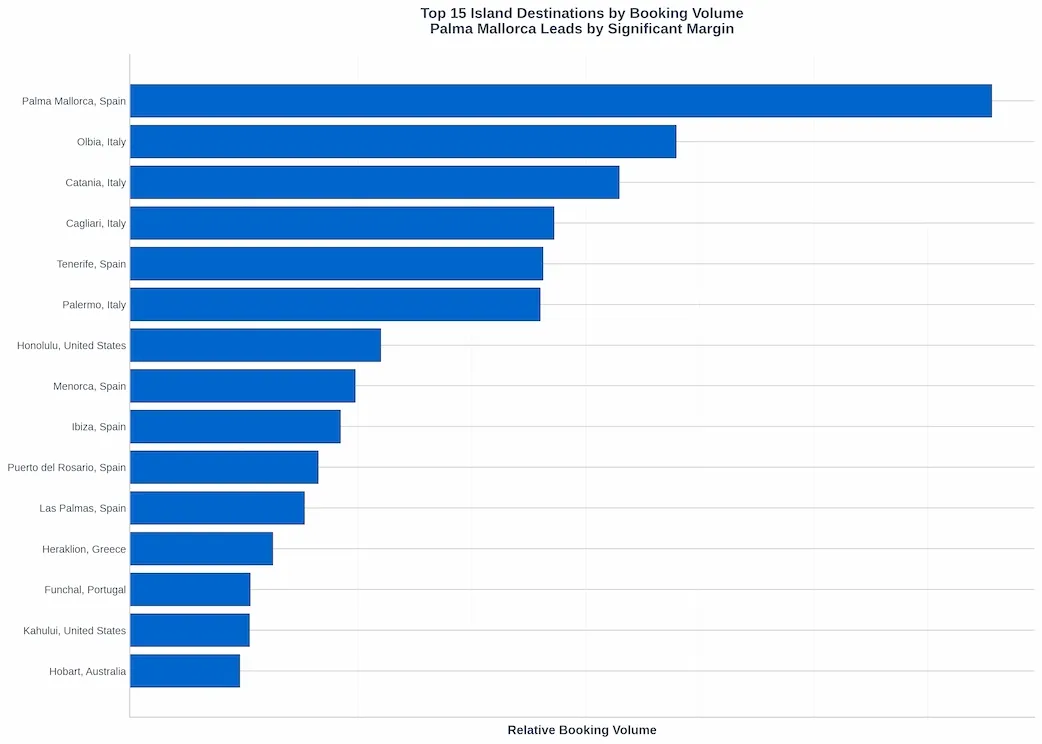
Notice Palma Mallorca. Very high booking volume at $28 per day. That volume creates economies of scale. Companies spread fixed costs across more transactions.
Hub Islands
Malta and Cyprus fall into this category. These islands serve as regional transportation hubs. Ferry connections to mainland Europe. Mixed business and leisure traffic. Year-round operations rather than pure seasonal tourism.
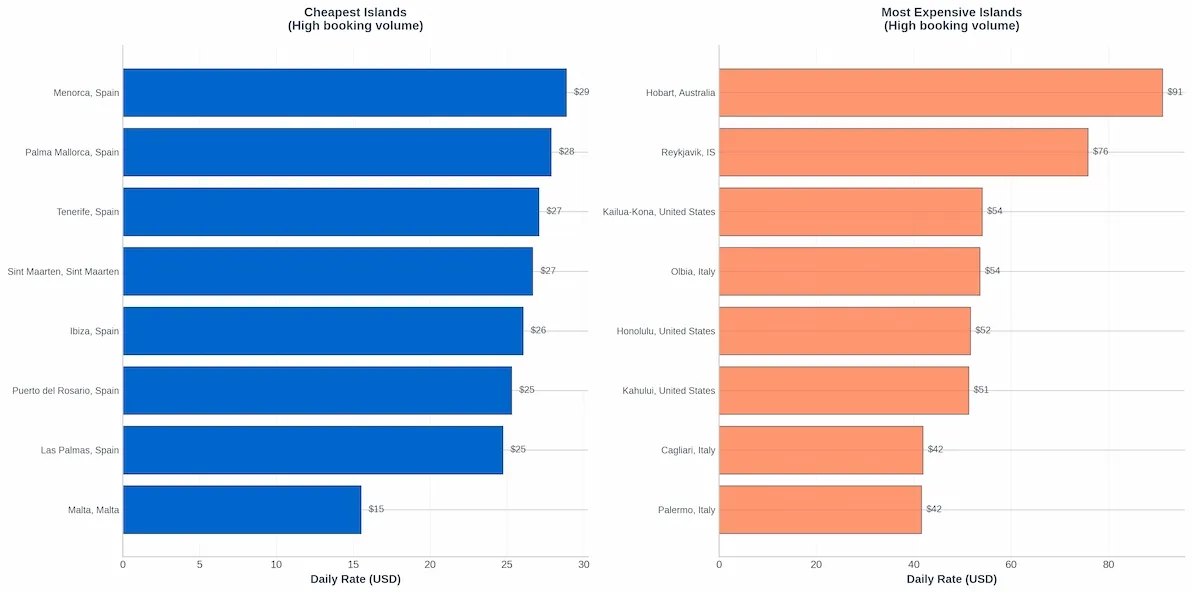
Malta costs $15 per day. That's the cheapest destination in our entire database. Cheaper than Portugal at $28 per day. Cheaper than any Spanish city. Cheaper than anywhere.
Premium Islands
Remote islands with limited infrastructure show the expected premium. Iceland costs $76 per day. Tasmania costs $91 per day. These destinations have expensive domestic economies, limited rental fleets, and shorter tourist seasons.
This is where the island premium actually appears. But it's driven by geography and economy, not by being an island. Iceland's high cost of living affects all prices. Tasmania's isolation from mainland Australia creates supply constraints.
The Spanish Island Phenomenon
Spanish islands deserve specific attention. Six major Spanish islands all beat Barcelona on price. All six rank among the cheapest island destinations in our data.
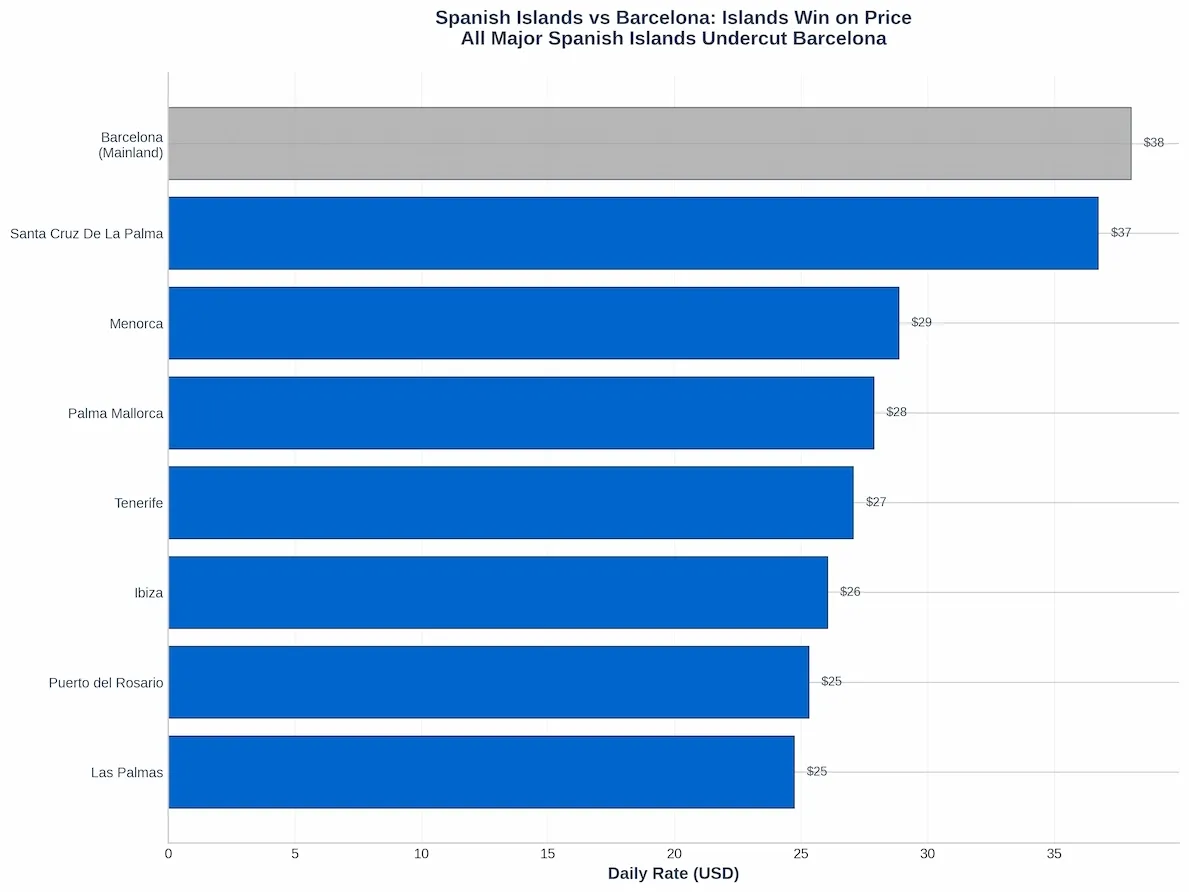
Barcelona costs $38 per day. Every Spanish island in our data costs less. Las Palmas and Puerto del Rosario in the Canary Islands cost $25 per day. Ibiza costs $26. Tenerife costs $27. Palma Mallorca costs $28. Menorca costs $29.
The difference compounds over a week. Seven days in Mallorca costs $196. Seven days in Barcelona costs $266. That's $70 saved by choosing the island.
Why does this pattern hold across all Spanish islands?
Northern European tourism drives the answer. British, German, and Scandinavian travelers flood Spanish islands seeking winter sun. Multiple rental companies compete for this concentrated market. The islands become price-competitive rather than premium destinations.
Mainland Spanish cities serve more diverse markets. Domestic business travel. International cultural tourism. Weekend trips. That diversity reduces pricing pressure from any single customer segment.
Italian Islands Match the Mainland
Italian islands tell a different story than Spanish islands. They match mainland pricing rather than undercutting it.
Catania in Sicily costs $34 per day. That matches Naples on the mainland. Palermo costs $42 per day. Cagliari in Sardinia costs $42 per day. Both cost more than Rome at $40 per day but less than Milan at $48 per day.
Only Olbia breaks this pattern at $54 per day. But Olbia serves as the gateway to Sardinia's Costa Smeralda, where luxury positioning drives higher prices across all services.
The key insight? Italian islands don't cost less than the mainland. But they don't cost more either. The island premium myth doesn't hold.
Hawaii Breaks Expectations
Hawaii should be expensive. It's the most isolated island chain in our data. Thousands of miles from the US mainland. Limited vehicle supply from ferry logistics to get cars to the islands.
Honolulu costs $52 per day. The US mainland average costs $52 per day. Hawaii matches the mainland exactly.
Maui costs $51 per day. Big Island costs $54 per day. All three major Hawaiian islands cluster around the US average with no premium.
Why no premium for the most remote islands?
Year-round domestic US tourism creates consistent demand. Established rental infrastructure operates at scale. The market functions efficiently despite geographic isolation.
Hawaii also lacks European-style seasonality. Mainland US visitors travel year-round. Christmas and summer both see high volumes. This steady demand keeps operations efficient and pricing stable.
What People Actually Rent on Islands
Vehicle preferences differ dramatically between islands and mainland cities.
The Fiat 500 dominates island rentals. The most popular car across all islands in our data. The Fiat Panda follows close behind. These ultra-compact vehicles represent island reality. Narrow roads. Limited parking. Fuel efficiency matters on small islands with contained driving distances.
- Fiat 500: Most popular overall at $32/day average
- Fiat Panda: Second most popular at $31/day average
- Renault Captur: Third most popular at $37/day average
- Toyota Aygo: Popular choice at $32/day average
- Volkswagen Polo: Solid option at $25/day average
Malta takes this further. The Peugeot 108 and Nissan Micra lead bookings at $9 to $15 per day. These ultra-small city cars match Malta's compact size and narrow streets.
Spanish islands show interesting variation. While Fiat 500 and Panda dominate, the Toyota Aygo appears frequently at $32 per day. Slightly larger than the smallest city cars but still compact enough for island roads.
Hawaii breaks the pattern entirely. Ford Focus leads bookings at $38 per day. Mazda 3 and Jeep Cherokee follow. American tourists rent American-style sedans and SUVs. The islands have US road infrastructure to support larger vehicles.
This matters for pricing. Small vehicles cost less. European tourists booking Fiat 500s on Spanish islands pay $22 to $24 per day on average. American tourists booking Ford Focus in Hawaii pay $38 per day. Vehicle choice directly affects total cost.
How Long People Stay
Islands attract longer rentals than mainland cities. Islands average 6.3 days. Mainland averages 5.4 days.
That one extra day signals different trip purposes. Islands mean vacation. Mainland means mixed business and leisure.
Some islands see particularly long stays. Puerto del Rosario in the Canary Islands averages 8.3 days. Cagliari in Sardinia averages 7.1 days. Las Palmas averages 7.0 days. Olbia averages 6.9 days. Palermo averages 6.8 days.
Compare that to mainland cities. Barcelona averages 4.6 days. Madrid averages 5.1 days. Milan averages 5.7 days.
The difference compounds pricing advantages. A cheaper daily rate stretched over more days amplifies savings. Seven days in Tenerife at $27 per day costs $189 total. Five days in Madrid at $41 per day costs $205 total. The island costs less despite being an extra two days.
Seasonal Swings Match the Mainland
We expected islands to show more extreme seasonal pricing than mainland cities. Limited capacity plus peak season demand should create bigger swings.
The data doesn't support that theory.
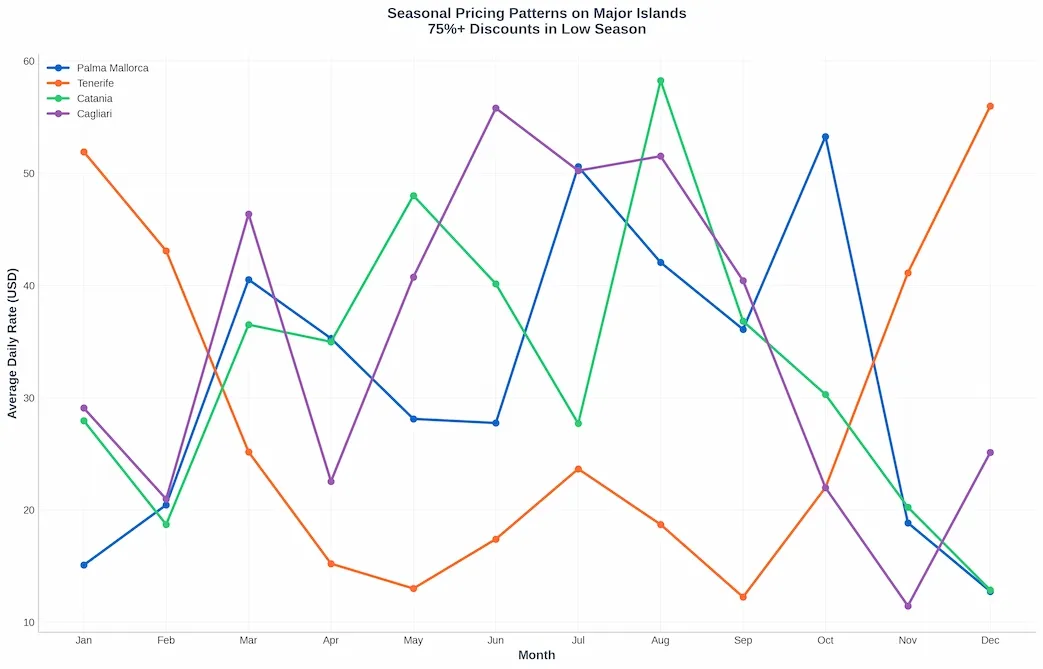
Catania drops from $58 per day in August to $13 in December. That's a 78% discount in winter. Cagliari drops from $58 in June to $11 in November, an 81% discount. Palma Mallorca drops from $43 in October to $13 in December, a 70% discount.
These swings mirror mainland patterns. Spain drops from $89 per day in July to $17 in January (from our earlier analysis). Italy drops from $103 to $23. The 80% swing appears in both island and mainland markets.
Why no difference?
Both island and mainland Mediterranean destinations depend on the same Northern European tourist flows. Germans, British, and Scandinavians visit in summer and disappear in winter. That creates identical pricing dynamics.
The only difference? Islands get more international visitors year-round. Some Northern Europeans specifically seek island winter sun. But not enough to flatten seasonal curves.
Airport vs City Center Pricing
Conventional wisdom says airport pickups cost more. Convenience premium for arriving travelers. Captive market at terminals.
Islands flip this pattern.
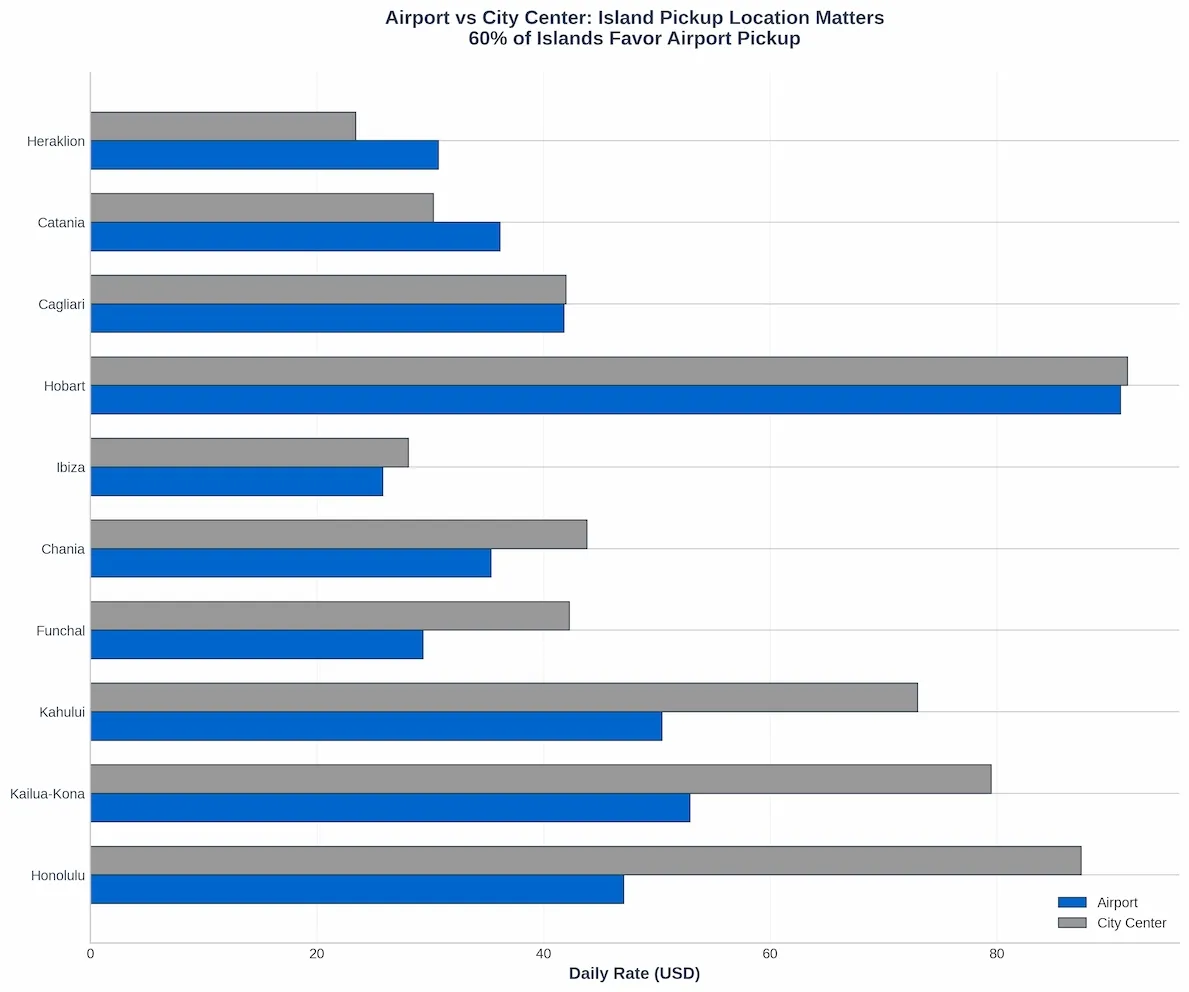
Sixty percent of islands in our data show cheaper airport pricing than city center pickup. The opposite of expectations.
Honolulu shows the most dramatic difference. Airport pickups cost $47 per day. City center locations cost $87 per day. That's a $40 daily difference. Choose the airport and save $280 on a week rental.
Palma Mallorca shows airport savings of $8 per day. Reykjavik shows $43 per day savings at the airport. Funchal in Madeira saves $13 per day at the airport.
Why does this pattern exist?
Island airports concentrate rental operations. Most tourists arrive by air rather than ferry. Companies focus inventory and staff at airports. Competition at the airport location drives prices down.
City center locations serve a smaller market. Local residents, business travelers, cruise ship passengers. Lower volumes mean less aggressive pricing.
Some islands do show the traditional airport premium. Malta, Palermo, Catania, Menorca, and Olbia all cost more at airports than city centers. But the price differences are small. $4 to $9 per day. Nothing like the $40 daily difference in the opposite direction that Honolulu shows.
Planning Timeline Differs
Islands require more advance planning than mainland cities. Islands average 28 days of booking lead time. Mainland averages 15 days.
That nearly double lead time reflects limited inventory. Popular islands have finite rental fleets. Summer season books up early. Companies don't maintain excess inventory that sits idle in winter.
Some islands require particularly long planning windows. Reykjavik averages 51 days advance booking. Sint Maarten averages 43 days. Menorca averages 42 days. Hobart averages 40 days. Funchal averages 36 days.
Compare to mainland cities. Barcelona averages 12 days. Madrid averages 14 days. Milan averages 15 days.
The practical advice? Start planning island trips at least four weeks out. Mainland cities give you more last-minute flexibility.
The Patterns That Matter
You can't reduce island pricing to a simple rule. But clear patterns emerge from the data.
Spanish islands cost $25 to $29 per day. That's 26% cheaper than Barcelona and cheaper than most mainland European cities. Mallorca, Tenerife, Ibiza, and Menorca all deliver consistent value.
Italian islands match mainland pricing at $34 to $42 per day. Sicily and Sardinia won't save you money over Rome, but they won't cost more either.
If cost matters, Spanish islands beat Spanish mainland. Italian islands break even with Italian mainland.
At $15 per day, Malta costs less than anywhere else in our database. Less than Portugal. Less than Romania. Less than any Spanish island despite being similar in appeal.
If you're comparing Mediterranean island destinations and budget is a factor, Malta offers unmatched value. The only downside is its small size. A week there might feel long for some travelers.
Honolulu at $52 per day equals the US average. Maui and Big Island cluster around the same point. No island premium exists for America's most isolated island chain.
If you're choosing between a US mainland destination and Hawaii based on rental costs, they're equivalent. Other factors like airfare and hotels will determine total trip economics.
Sixty percent of islands favor airport pickups. Honolulu saves you $40 per day at the airport. Reykjavik saves $43 per day. Even modest differences like Palma Mallorca's $8 per day add up over a week.
Don't assume airport means premium pricing. On islands, it often means the opposite.
Islands average 28 days booking lead time versus 15 days for mainland. Limited inventory on popular islands means early booking matters.
Spanish islands, Hawaiian islands, and Mediterranean destinations all show this pattern. Plan island trips earlier than mainland trips.
The Fiat 500 and Fiat Panda dominate island bookings for good reason. Narrow roads, limited parking, and short driving distances make compact cars practical.
Plus they cost less. European mini and economy cars average $31 to $33 per day on islands. Intermediate and larger vehicles cost $54+ per day.
Unless you need space for large families or lots of luggage, small vehicles make sense on most islands.
Mediterranean islands drop 75% from summer to winter. Mallorca goes from $53 to $13. Catania drops from $58 to $13. Cagliari falls from $56 to $11.
This matches mainland patterns. If you have schedule flexibility, Mediterranean winters offer the best value anywhere. The weather stays mild. Tourist crowds disappear. And prices crater.
When Islands Actually Cost More
We should be clear about where the island premium exists. It's real in specific markets.
Remote expensive-economy islands like Iceland show substantial premiums. Reykjavik costs $76 per day. That's 67% more than the European island average.
Tasmania costs $91 per day. Australian mainland cities average $63 per day. That's a 44% island premium driven by isolation from mainland Australia and limited ferry transport for vehicles.
Exclusive boutique islands we don't have enough data for probably show premiums too. Santorini and Mykonos in Greece likely cost more than mainland Athens. Small Caribbean islands with limited infrastructure probably exceed mainland Central American cities.
The point isn't that islands never cost more. It's that the blanket assumption of island premiums is wrong. Mass tourism islands undercut mainland cities. Hub islands offer exceptional value. Only remote or exclusive islands show expected premiums.
The Bottom Line
Islands are 9.4% cheaper than mainland cities on average. That's the opposite of what common wisdom predicts.
Malta costs $15 per day, making it the cheapest destination in our entire database. Spanish islands undercut Barcelona by 26%. Hawaiian islands match US mainland average. Italian islands break even with Rome.
The island premium myth comes from looking at the wrong islands. Remote expensive-economy destinations like Iceland and Tasmania do cost more. But mass tourism islands and hub islands offer equal or better value than comparable mainland cities.
What matters isn't island versus mainland. It's island type. Choose destinations with high competition and established tourism infrastructure. Avoid remote islands with expensive domestic economies.
Choose islands when:
- Looking at Spanish islands (all undercut Barcelona)
- Considering Malta (cheapest anywhere)
- Comparing Hawaii to US mainland (equal pricing)
- Planning week-long vacations (islands = vacation trips)
- Traveling in winter to Mediterranean (75%+ discounts)
Choose mainland when:
- Booking last minute (mainland has more flexibility)
- Needing larger vehicles (islands favor small cars)
- Taking short trips (mainland serves business/weekend better)
- Visiting remote premium islands (Iceland, Tasmania cost more)
The data shows what travelers already suspected. Islands aren't automatically more expensive. The right islands offer exceptional value. And the common assumptions about island pricing don't hold up to scrutiny.
Methodology
This analysis examines over 11,000 completed island bookings and over 17,000 mainland city bookings from the Carla platform. Data spans three years from 2023 through 2025.
Island destinations include: Palma Mallorca, Olbia, Catania, Cagliari, Tenerife, Palermo, Honolulu, Menorca, Ibiza, Puerto del Rosario, Las Palmas, Heraklion, Funchal, Kahului, Hobart, Kailua-Kona, Malta, Reykjavik, and Sint Maarten.
Mainland comparison cities include: Milan, Los Angeles, Rome, Naples, Barcelona, San Francisco, Miami, Lisbon, Florence, Madrid, Porto, Faro, Athens, Valencia, Sydney, Melbourne, Thessaloniki, and others.
All prices converted to USD at time of booking. Daily rates calculated as total rental cost divided by rental days. Seasonal data aggregates monthly averages across multiple years. Vehicle data reflects actual customer choices from completed bookings.
Only destinations with substantial booking volumes included to ensure reliable averages. Prices reflect completed transactions, not advertised rates. Your actual price depends on specific dates, vehicle choice, and booking conditions.
Analysis by Süleyman Özcan, Carla Growth Team, travel enthusiast |
January 2026
Based on over 11,000 island bookings and over 17,000 mainland
bookings